Termite Warning Signs on a Slab Home, and What to Do the Day You See Swarmers
Termites work out of sight for months, so the signs you can see are worth learning before you need them.
October 8, 2026 · 4 min read
Termites are quiet. A colony can feed on the wood in a house for a long time without anyone noticing, because the damage happens inside walls, behind trim and under flooring. That's the reason most homeowners find out by accident, when a screwdriver goes through a window frame or a cloud of winged insects shows up on a windowsill. Knowing the early signs gives you a chance to catch it before the repair bill grows. Rivers Pest Control puts it on its graphics as protecting your investment, and for most people the house is exactly that.
Why slab homes need a close look
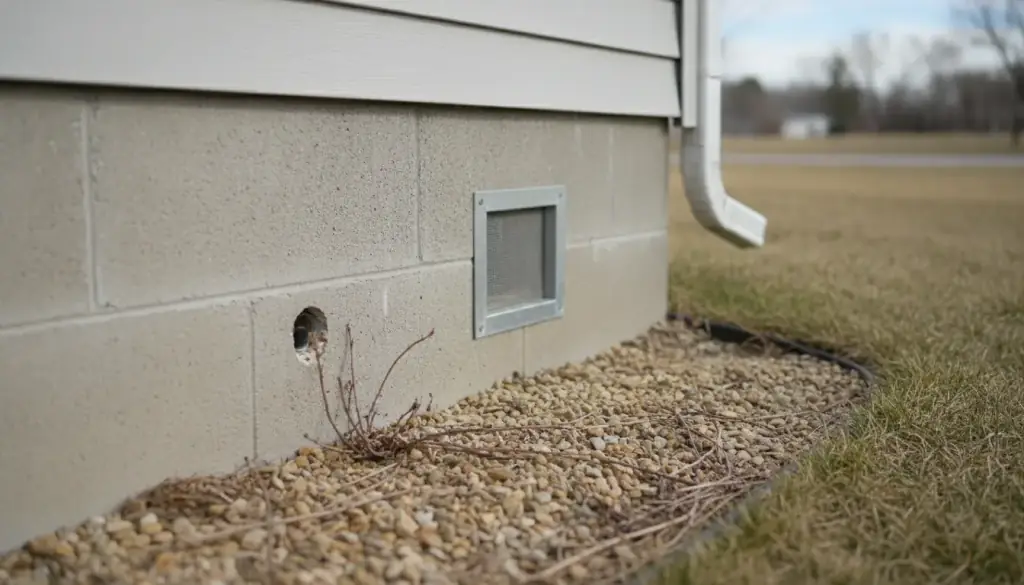
Most of the houses around Lindale sit on a concrete slab, and people sometimes assume that makes them safe. It doesn't. Subterranean termites live in the soil and travel through tiny cracks, expansion joints, and the openings around plumbing lines that come up through the slab. They need very little room to get in, and a crack thinner than a pencil line can be enough.
East Texas soil and humidity keep conditions friendly for them. Add a flower bed that holds water against the foundation, a wooden fence post touching the siding, or a downspout dumping next to the slab, and you've built a route. The goal is to spot the first sign and call before they've had a full season to feed.
Mud tubes on the foundation
Subterranean termites build thin tunnels out of soil and saliva so they can travel between the ground and the wood without drying out. These mud tubes are about the width of a pencil and run up the face of the slab, the brick, a pier or the inside of a garage wall. They look like a dirt line someone drew with a finger.
Check the foundation line on all sides, the garage walls, the area around the water heater, and anywhere plumbing comes through. If you find a tube, don't scrape it away before someone has looked at it. An inspector can learn a lot from where it starts and where it ends.
Swarmers in the spring
Swarmers are the winged termites that leave a mature colony to start new ones. In this part of Texas they often show up in spring, especially on a warm day after rain. You'll find them near windows, door frames and light fixtures, and afterward you'll find small piles of shed wings on sills and floors.
They get confused with flying ants, and the difference is worth knowing. A termite has a thick, straight body with no pinched waist, straight beaded antennae, and four wings that are all the same length. A flying ant has a narrow waist, elbowed antennae and front wings longer than the back ones. If you see a pile of wings indoors, that's a stronger warning than seeing a few swarmers outside.
Soft or hollow-sounding wood
Termites eat wood from the inside, so the surface can look fine while the interior is hollow. Tap along baseboards, door frames and window trim with the handle of a screwdriver. A dull, papery sound means something has been eating the inside. Paint that bubbles or ripples without an obvious leak is another clue, and so are doors and windows that suddenly stick.
What to do the day you see swarmers
- Don't spray them with a store-bought can. It kills the ones you see and tells you nothing about the colony.
- Catch a few in a zip bag or a jar, or tape them to a card, so they can be identified.
- Take photos of the swarmers, the wings and the spot where you found them.
- Write down the date, the room and the weather.
- Call or text the office the same day.
You can vacuum up the rest once you've saved a sample. Then leave the area alone. The more evidence stays in place, the easier it is for a technician to see where the colony is getting in.
Reduce what termites need
Termites need moisture and wood. You can take both away from the foundation with a few small jobs: keep mulch and soil several inches below the siding, move firewood and lumber off the ground and away from the house, fix leaking pipes and hose bibs, and point downspouts away from the slab. Stucco and siding that run all the way down to the soil give termites a hidden path, so keep a visible band of concrete.
Termite Protection is one of the five core services Rivers Pest Control lists, and their graphic invites you to call for a free inspection. If you've spotted a mud tube, a pile of wings or a soft window frame, call or text (430) 260-7402, or visit the office at 407 S Main St, Suite 6, in Lindale.
Rivers Pest Control, (430) 260-7402
Call (430) 260-7402More articles
What a Quarterly Pest Control Visit Actually Covers at Your Home
Four visits a year sounds simple, so here is what the technician does, room by room and wall by wall.
Why East Texas Heat Sends Ants and Roaches Indoors in Late Summer
When the yard dries out, your kitchen starts looking like the best water source for a quarter mile.